 (323) 441-0108

Custom Awnings West Hollywood CA: A Local’s Guide to Permits, Materials & Style 31 March, 2026 – Posted in: Sin categoría
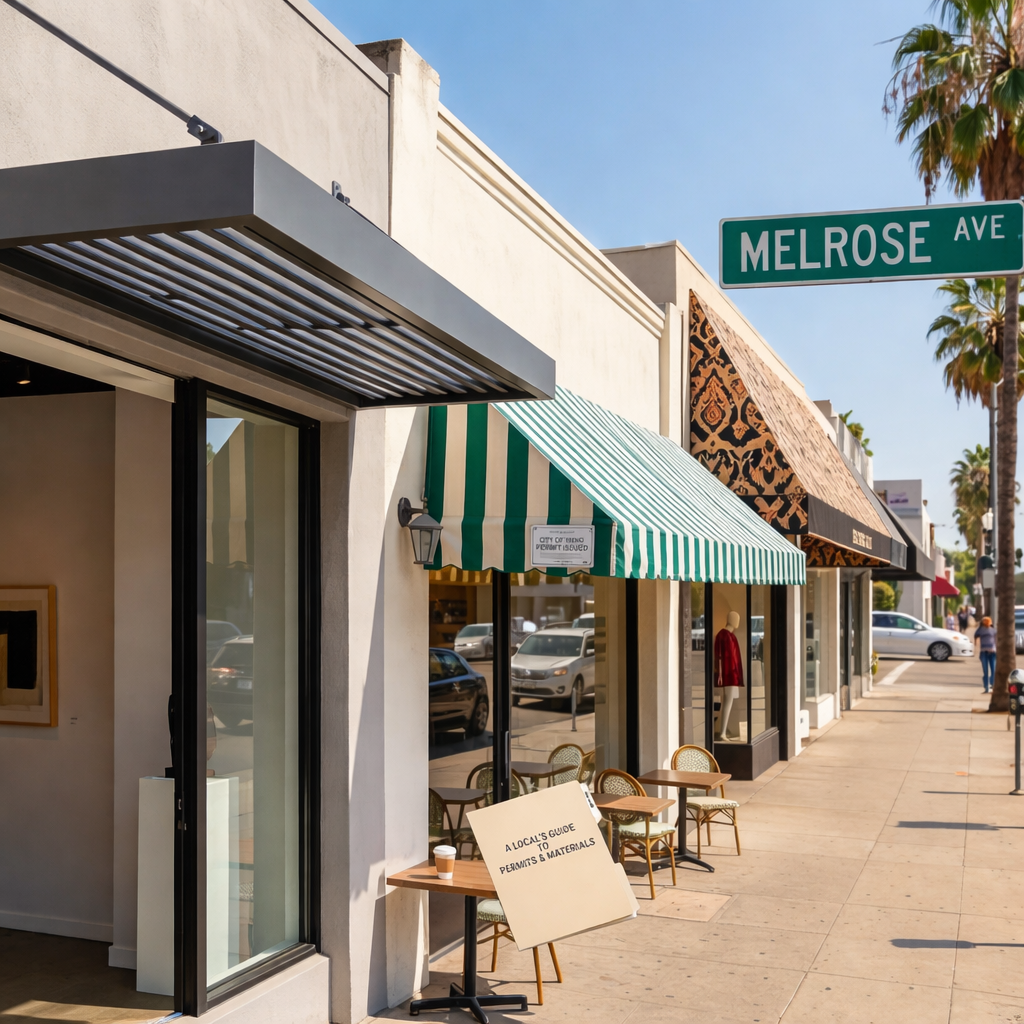
Most residential awnings in West Hollywood don’t require a structural building permit — but they do require Planning Division approval before anything is installed. The exemption applies when the awning projects no more than 54 inches from the exterior wall and stays outside required yard setbacks. Commercial storefronts on Santa Monica Blvd, Melrose, and the Sunset Strip follow a stricter path: Planning approval must come before Building & Safety review, and any projection over the public sidewalk requires a separate encroachment permit ($800 fee). For materials, solution-dyed acrylic on a powder-coated aluminum frame is the right choice for Southern California’s UV conditions, with a typical service life of 10 to 15 years. Custom fabrication and installation runs 4 to 6 weeks from first consultation to completed install.
Custom Awnings West Hollywood CA: A Local’s Guide to Permits, Materials & Style
- What to Know Before You Buy an Awning in West Hollywood
- Do You Need a Permit?
- Choosing a Style That Fits Your Property
- Awning Materials — What Holds Up in Southern California
- Retractable vs. Fixed — Which One Makes Sense for Your Space?
- What Does a Custom Awning Cost in West Hollywood?
- How Long Will It Last — and What Does Maintenance Look Like?
- What the Installation Process Actually Looks Like
- Why West Hollywood Homeowners and Business Owners Are Investing in Custom Awnings
- The Complete Guide to Awning Permits in West Hollywood, CA
- Best Awning Materials for Southern California’s Climate
- Retractable Awnings vs. Fixed Awnings — A Practical Comparison for West Hollywood Properties
- How Much Does Awning Installation Cost in Los Angeles and West Hollywood?
- How to Choose the Right Awning Company in West Hollywood and Los Angeles
- Awning Lifespan, Maintenance, and Repair in the Southern California Climate
- The Custom Awning Installation Process — From First Call to Finished Install
- Disclaimer
- Author & Content Transparency
What to Know Before You Buy an Awning in West Hollywood
West Hollywood operates as an independent municipality — not an unincorporated part of Los Angeles County — which means its building and planning departments set their own rules. That matters the moment you start shopping for custom awnings West Hollywood CA, because the process here runs through WeHo’s own permitting portal and planning division, not the county’s.
The city covers just under two square miles, but it packs in a dense mix of property types: mid-century residential neighborhoods like the Norma Triangle, high-traffic commercial corridors along Santa Monica Blvd and Melrose, and the intensely regulated Sunset Strip. Awnings serve different functions across all of them — passive solar control and patio expansion for a backyard or balcony, weather protection and brand identity on storefronts — but the starting point is the same for every property owner: understanding what the city requires before anything gets installed.
West Hollywood’s climate adds urgency to the conversation. The city sits in a high-UV, low-humidity environment with seasonal Santa Ana wind events that put real stress on exterior structures. On sunny days, west-facing exposures can make an uncovered patio nearly unusable by mid-afternoon.
The other variable that catches people off guard is property type. Single-family homes, condos, multi-unit buildings, and commercial storefronts each travel a different approval path — and in many cases, the municipal permit process is actually the second step, not the first.
Do You Need a Permit?
Residential installs — when you do and don’t need one
West Hollywood’s Building & Safety FAQ includes a specific exemption for residential awnings: canopies or awnings attached to a residence are exempt from a structural building permit if they project no more than 54 inches from the exterior wall and don’t encroach into required yard setbacks (City of West Hollywood Building & Safety FAQ).
That exemption covers most standard retractable awnings West Hollywood homeowners install on patios and decks. But the exemption only removes the structural building permit — it does not skip Planning Division review. The city requires Planning approval for exterior modifications even when Building & Safety isn’t involved. That’s a step many first-time buyers miss entirely.
When does a residential installation require a full building permit? When the projection exceeds 54 inches, when there’s significant structural wall attachment work, or when a motorized unit requires new electrical wiring at 25 volts or higher. If your project touches any of those conditions, you’re in permit territory.
For condos and multi-unit buildings, there’s an additional step:
👉 HOA approval comes first—before any city submission.
Under California Civil Code (§4765), HOAs must:
- Provide a fair review process
- Issue written decisions
- Offer a reconsideration option if denied
Start with your HOA—not the city.
Commercial installs on Santa Monica Blvd, Melrose, and the Sunset Strip
Commercial awning installation is a different process entirely. The city’s Commercial Awnings & Canopies handout establishes that Planning review and approval must happen before the project is submitted to Building & Safety — not after, and not simultaneously.
For storefronts projecting an awning over the public sidewalk, an encroachment permit from the Public Works Engineering Division is also required. That permit requires a Certificate of Insurance naming the City of West Hollywood as an additional insured party, a valid California contractor’s license, a city Business Tax Certificate, and a formal Traffic Control Plan. The administrative fee for encroachment permits is $800.
Along the Sunset Strip, awnings fall under the Sunset Specific Plan — a form-based design framework the city adopted in 1996 and amended in 2019. Commercial awnings that incorporate signage face additional restrictions: the West Hollywood sign standards allow awning signs only as an integral part of the structure itself, with structural elements no lower than 8 feet above finished grade and valances permitted down to 7 feet.
The WeHo permit process, step by step
Since August 2024, West Hollywood has processed all permit applications through its online Permit & License Portal. Physical plan submissions are not accepted. The practical sequence:
- Zoning check — Confirm your property’s zone and whether any overlay (Sunset Specific Plan, Design District) imposes additional design review requirements.
- Planning approval — Required for commercial projects before Building & Safety review. Required for residential even when Building & Safety permits are waived.
- Prepare submittal package — For commercial: structural drawings, site plan, elevation drawings with dimensions, attachment details, and wind-load calculations sealed by a California-licensed engineer or architect.
- Submit via portal — Applications are processed within approximately 3 business days. Prescreening of uploaded documents takes a minimum of 3 additional business days.
- Encroachment permit (if projecting over public right-of-way) — Filed through the Public Works Engineering Division separately.
- Inspection and sign-off — Required when structural connections, new electrical, or encroachment work is involved.
Choosing a Style That Fits Your Property
Modern and mid-century homes
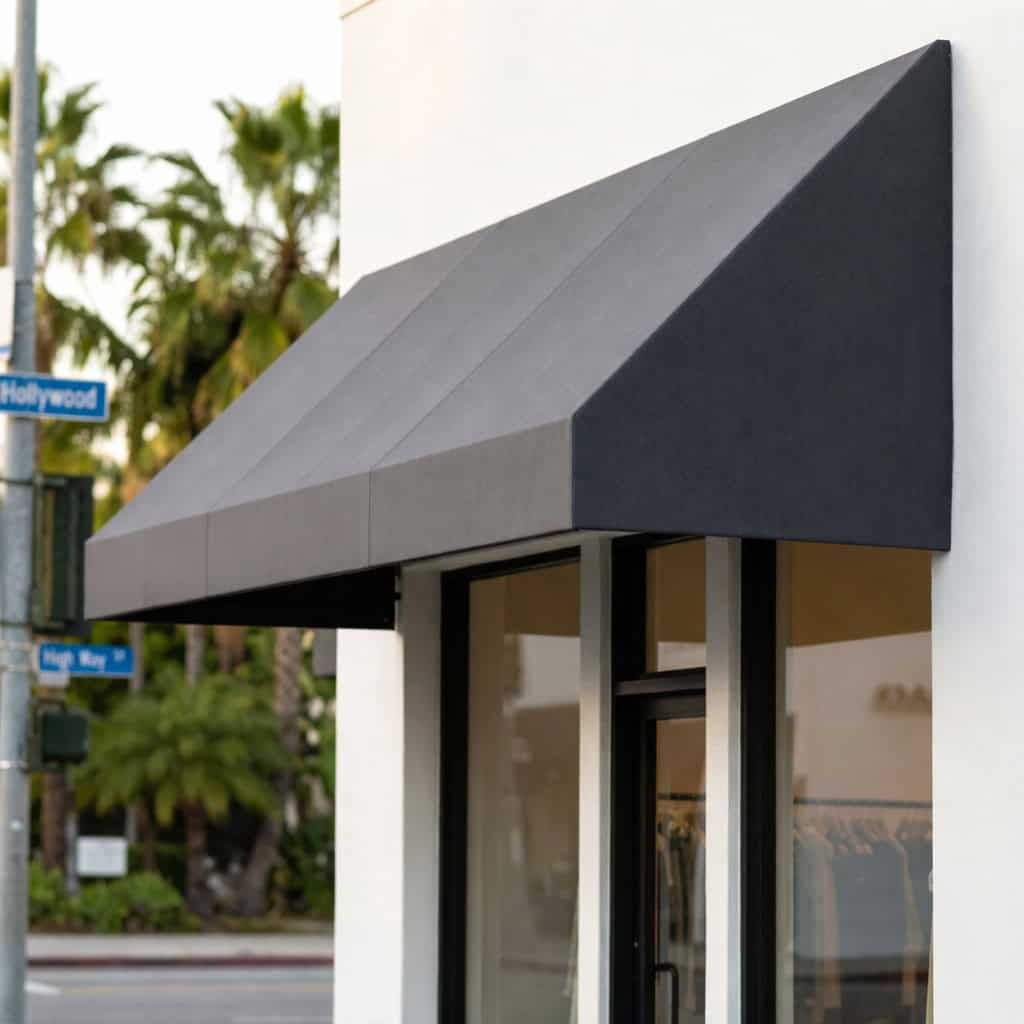
West Hollywood’s residential stock includes a high concentration of mid-century modern homes — flat-roofed, horizontal, with clean unornamented facades. Awnings on these properties need to follow the same logic: straight valances, neutral or single-color fabrics, powder-coated aluminum frames in charcoal or matte black. Slide-on-wire canopies and full-cassette retractable units that conceal the mechanism when retracted work well here. The cassette detail matters aesthetically — it keeps the facade reading clean when the awning isn’t deployed.
Spanish Colonial, Craftsman, and older residential
Period Revival styles from the 1920s and 1930s — stucco exteriors, red tile roofs, arched windows — take awnings best in canvas awnings West Hollywood installers typically spec in warm earth tones: terracotta, deep olive, dusty cream. Scalloped or spear-style valances complement arched doorways and wrought-iron hardware. Fabric awnings West Hollywood CA in this category tend toward woven textures rather than high-gloss synthetics.
Craftsman properties follow similar logic: deep, organic colors (burgundy, warm beige, forest green) and natural-looking fabric weights. High-gloss vinyl reads wrong against handcrafted woodwork and natural stone foundations.
Commercial storefronts
On storefronts, the awning carries two jobs at once: provide shade for pedestrians and brand presence from the street. In the West Hollywood Design District along Melrose and Robertson, projections need to deliver both without overwhelming the building’s transparency. The city caps awning signage at 20% of the ground-floor window area — so the awning’s design has to do visual work without depending on an oversized logo.
Projection depth, stripe versus solid patterns, and integrated valance lighting (directed downward, not illuminating the fabric itself) are all elements that distinguish window covers and door awnings West Hollywood CA that build brand recognition from those that merely block sun. Window awnings West Hollywood CA used as window treatments on high-visibility storefronts pull double duty: solar control during the day and brand visibility from the street.
Awning Materials — What Holds Up in Southern California
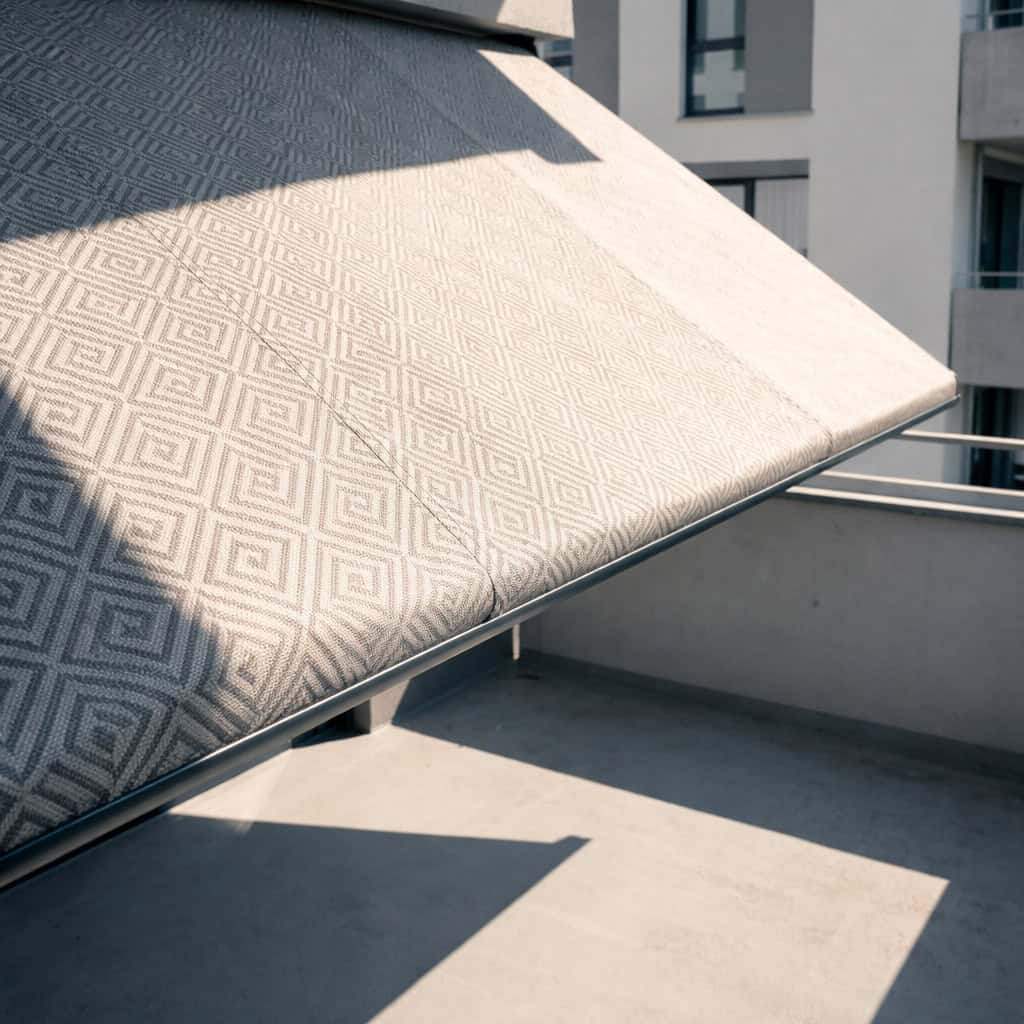
Southern California’s outdoor materials environment is less forgiving than most property owners expect. UV radiation is relentless year-round, Santa Ana winds create sudden high-stress load events, and the marine layer brings periodic moisture that settles into unventilated fabric structures. The right material choice is determined almost entirely by your specific exposure and use pattern.
| Material | UV Resistance | Fade Lifespan | Best Application |
|---|---|---|---|
| Solution-dyed acrylic | Excellent | 10–15 years | Residential patios, west-facing exposures |
| Vinyl-coated polyester | Moderate | 5–10 years | Covered commercial, low-sun applications |
| Natural canvas | Poor | Varies with maintenance | Traditional aesthetic, low-UV exposure |
| Powder-coated aluminum | No fade | 20+ years (frame) | Commercial permanent shade, industrial look |
Acrylic fabric (solution-dyed)
For west-facing exposures — the most punishing orientation in Southern California — solution-dyed acrylic is the practical standard. The manufacturing process saturates the acrylic fiber with pigment before it’s extruded, so the color runs through the material rather than sitting on the surface. UV exposure bleaches surface-dyed fabrics; it can’t bleach what’s inside the fiber. Beyond the fabric itself, uv damage to outdoor furniture, flooring, and interior furnishings near windows is significantly reduced when a quality awning intercepts sunlight before it enters the space.
Breathability is the other advantage that’s often overlooked. Solution-dyed acrylics allow hot air to escape through the weave rather than trapping it beneath the canopy — a meaningful difference on a summer afternoon when temperatures under a vinyl canopy can spike uncomfortably.
Aluminum
Aluminum awnings West Hollywood CA makes the most sense for permanent commercial applications and any residential installation where the priority is zero ongoing maintenance. The material is impervious to UV fading and fabric degradation, and powder-coated finishes resist corrosion and urban smog accumulation. The trade-off is rigidity: aluminum patio awning options don’t retract, which limits flexibility for residential patios where owners want both sun and open sky depending on the season.
Canvas and vinyl
Canvas is the traditional choice and still has a role in lower-UV or covered installations. But in direct Southern California sun, natural canvas requires re-waterproofing every five to seven years and degrades faster than modern synthetics. Vinyl’s waterproofing is its strength and its limitation: it handles rain but traps heat, making the space beneath uncomfortable in summer and creating cracking risk as plasticizers dry out under repeated thermal cycling.
Retractable vs. Fixed — Which One Makes Sense for Your Space?
For residential patios, the answer is almost always retractable. How to choose a patio awning comes down to one central question: do you need flexibility or permanence? Retractable systems are available in manual or motorized operation — manual for simplicity and lower cost, motorized for automatic deployment via sun and wind sensors. The ability to extend coverage during peak afternoon hours and retract before a wind event dramatically extends fabric lifespan — and keeps the patio usable as an open-air space when shade isn’t needed.
For storefronts, fixed wins. Continuous pedestrian shelter, permanent branding presence, and structural integration with the building facade are all arguments for fixed commercial awnings West Hollywood that don’t depend on someone deploying them each morning.
Pergola vs. awning: These are fundamentally different structures. An awning is a cantilevered system attached to the building wall, requiring no ground footprint. A pergola is a freestanding architectural structure with vertical support columns and an open or louvered roof. Pergolas require concrete footings, often trigger stricter building permits due to their structural mass and permanent footprint, and cost significantly more. West Hollywood’s residential permit exemption (54-inch projection, no setback encroachment) applies to awnings — pergolas typically fall outside that profile entirely.
What Does a Custom Awning Cost in West Hollywood?
Cost varies across a wide range depending on the mechanism, materials, size, and whether commercial engineering is involved. These are realistic ranges for the Los Angeles market, where labor rates run higher than national averages (HomeAdvisor cost data):
| Type | Installed Cost Range |
|---|---|
| Manual retractable, residential | $800 – $2,500 |
| Motorized retractable, residential | $2,500 – $7,000 |
| Fixed residential (window/door) | $250 – $1,500 |
| Fixed commercial | $1,500 – $5,000+ |
| Large commercial / smart system | $6,000 – $15,000+ |
What drives the price up: full-cassette housing (adds cost, significantly extends fabric life), motorization with wind and sun sensors, custom color matching, complex valance fabrication, and in commercial work, the engineering package and permit fees. The $800 encroachment permit fee is a fixed cost for any installation projecting over the public sidewalk.
How Long Will It Last — and What Does Maintenance Look Like?
A properly maintained solution-dyed acrylic awning on an aluminum frame will typically deliver 10 to 15 years of service before the fabric needs recovering (Sunbrella performance estimates). The frame itself can outlast multiple fabric generations if kept clean and lubricated.
Maintenance is straightforward but non-negotiable in this climate:
- Bi-annual fabric cleaning using a soft brush and mild dish soap, followed by a thorough garden hose rinse. High-pressure washing destroys the water-repellent coating. Let the fabric dry fully in the extended position before retracting to prevent mold.
- Annual mechanical inspection of motor, tension springs, articulating arms, and mounting brackets on retractable units. Motorized systems also need annual calibration of wind and sun sensors.
- Lubrication with dry silicone spray — not petroleum-based products, which attract grit and can stain fabric.
Repair vs. replace decision: if the aluminum frame is structurally sound (no bent arms, no failed mounting brackets), a fabric recovering is almost always the right call. If the frame is damaged from a wind event or the mounting anchors show fatigue, full replacement is the safety-appropriate choice.
What the Installation Process Actually Looks Like
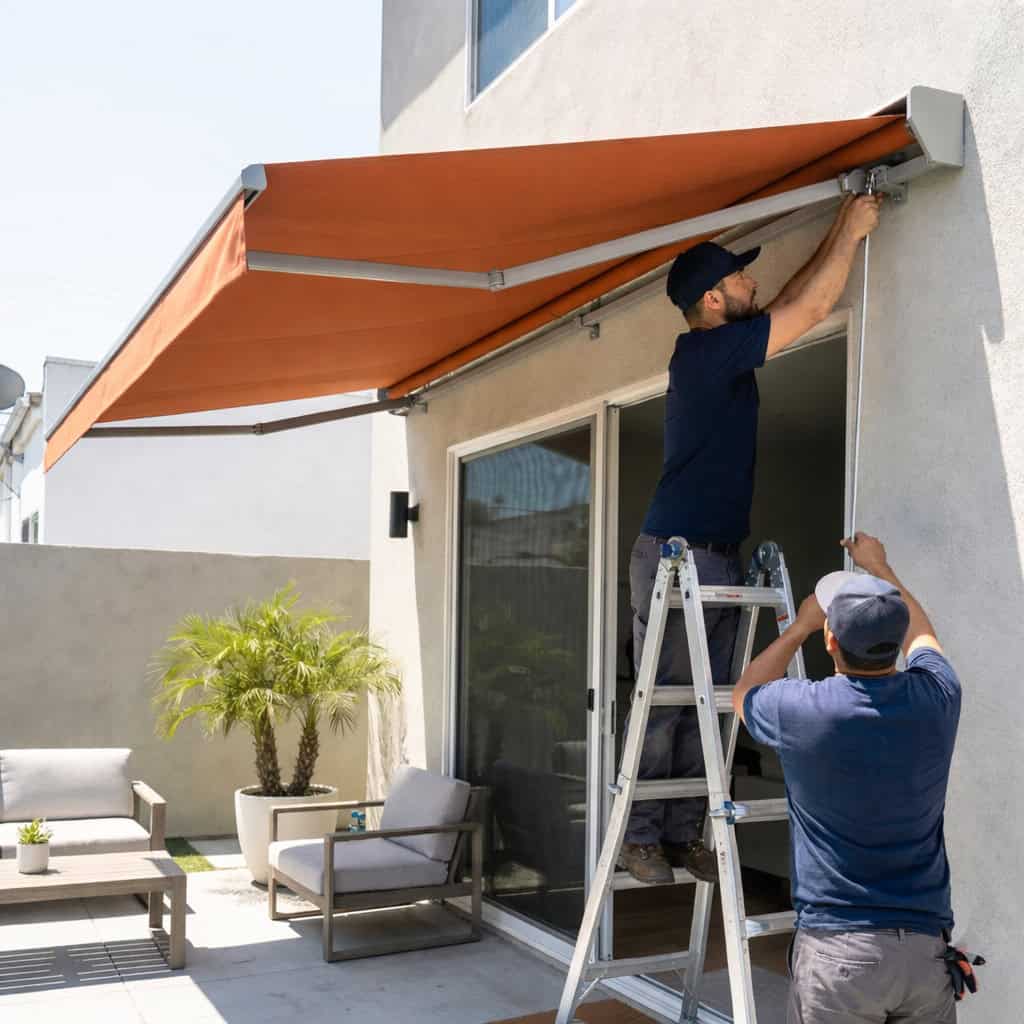
Custom awnings are built to order — fabricated to exact specifications based on precise site measurements. From first consultation to completed install, expect 4 to 6 weeks. That timeline breaks down as: 1–2 weeks for design, site measurements, and permit application preparation; 2–4 weeks of fabrication; and scheduling buffer for installation day.
The physical install is faster than most owners expect. A professional crew handles structural mounting, electrical wiring (motorized units), and operational calibration in 2 to 7 hours for standard residential projects. Commercial installations requiring encroachment permits may need 72-hour no-parking notices posted before work begins.
Before installation day: confirm the mounting wall is structurally sound and accessible, clear the patio or storefront approach area, and if you’re in a condo, have your HOA approval documentation ready — the installer will need it if inspectors visit.
For those who want the full technical breakdown, continue below.
Why West Hollywood Homeowners and Business Owners Are Investing in Custom Awnings
Custom awning investment in West Hollywood is driven by three overlapping factors: energy cost reduction, outdoor living expansion, and commercial revenue protection — all amplified by the city’s combination of high property values, outdoor dining culture, and year-round UV exposure.
Energy Efficiency and Solar Heat Reduction
The U.S. Department of Energy reports that window awnings can reduce solar heat gain by up to 65% on south-facing windows and up to 77% on west-facing windows — the most problematic orientation in the Southern California afternoon sun (DOE Energy Saver). In practical terms, shading windows before sunlight penetrates the glass is dramatically more efficient than cooling already-heated interior air.
A calibrated study conducted by Oak Ridge National Laboratory found that keeping operable awnings deployed from April through September reduced annual HVAC energy consumption by approximately 15% compared to unshaded baseline conditions. For West Hollywood homeowners paying Southern California Edison rates, that reduction translates to meaningful utility cost savings over the life of the installation.
These efficiency gains are particularly relevant for patio awnings West Hollywood CA homeowners install on west-facing exposures — the outdoor shade awning West Hollywood properties need most — where afternoon thermal load is highest and where the energy impact of shading is most significant.
Curb Appeal, Property Value, and Outdoor Living
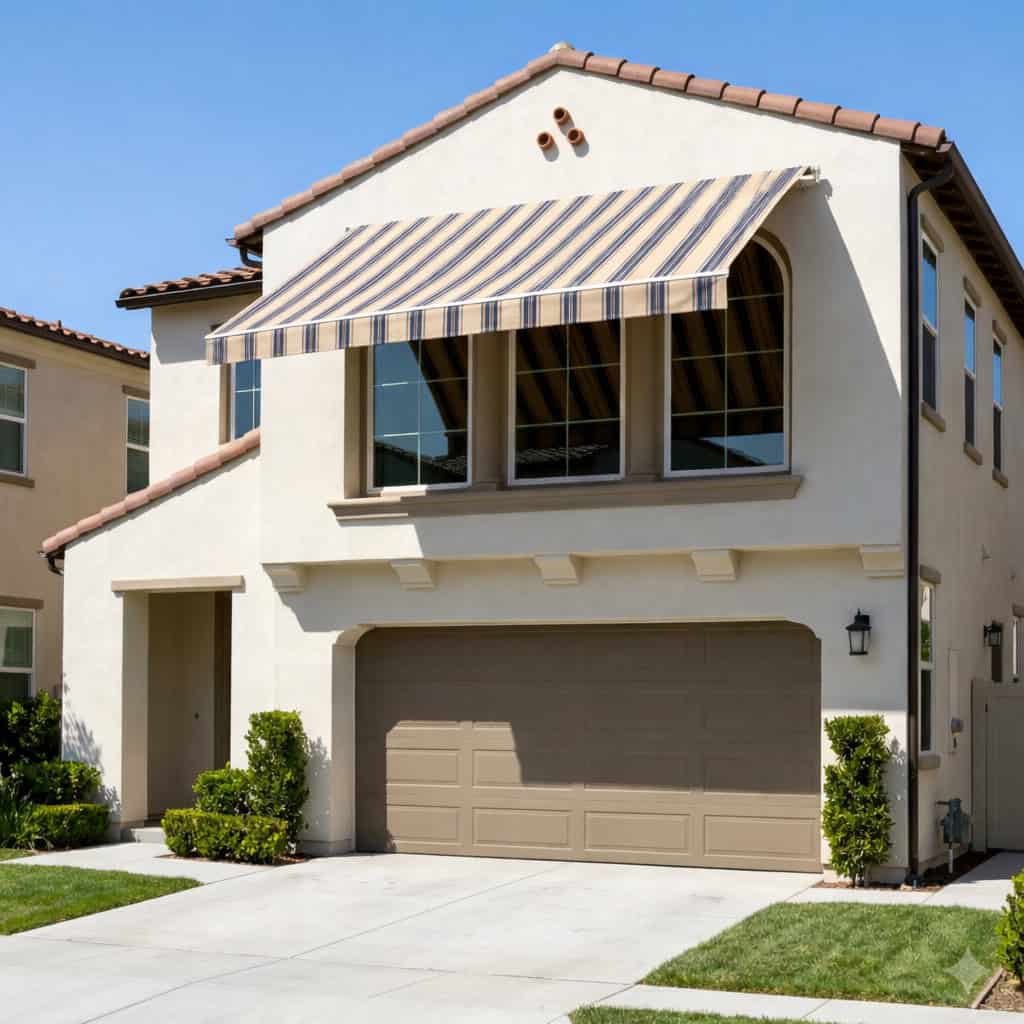
In a real estate market where residential awnings West Hollywood CA properties are trading at among the highest per-square-foot prices in the country, covered outdoor space represents a direct extension of usable square footage. In the Norma Triangle and other WeHo neighborhoods where lot sizes are compact, a well-designed awning system can effectively expand the functional living area by 15–25%.
Do awnings add value to home investment? Research is directionally consistent: covered outdoor entertaining space is consistently rated as a high-value exterior feature by buyers in the Southern California market. A patio cover awning West Hollywood properties add effectively functions as a permanent square footage expansion in a market where usable outdoor space commands a premium. West Hollywood patio shade solutions that are architecturally integrated — rather than bolted-on afterthoughts — tend to read as permanent improvements rather than removable accessories, which affects both appraisal language and buyer perception.
For commercial properties on Melrose and the outdoor dining corridors near the Sunset Strip, awnings directly protect revenue-generating square footage. A covered patio that remains functional during light rain or intense afternoon sun is a measurable business asset — particularly for restaurants that depend on outdoor dining permits that West Hollywood issues for specific square footage.
The Complete Guide to Awning Permits in West Hollywood, CA
Residential Awning Permits in West Hollywood — What the City Requires
The City of West Hollywood’s Building & Safety FAQ establishes a two-condition exemption for residential awnings: the structure must project no more than 54 inches from the exterior wall and must not encroach into required yard setback areas (City of West Hollywood Building & Safety FAQ). Both conditions must be satisfied simultaneously — meeting one but not the other does not preserve the exemption.
When the structural building permit is waived under this exemption, Planning Division approval is still required before installation proceeds. This is a formal administrative review, not a courtesy step. The Planning Division evaluates the proposed awning against the visual guidelines of the residential zoning district — size, color, projection profile, and compatibility with adjacent properties and streetscape.
Installations that exceed 54 inches in projection, involve significant structural attachment to the building framing, or require new electrical circuits operating at 25 volts or higher move into mandatory permit territory. Retractable patio awning installation that requires a new dedicated circuit will trigger both a building permit and a separate electrical permit, each with their own submittal and inspection requirements (City of West Hollywood Building & Safety).
Awnings must also comply with the California Building Code’s structural, wind-load, and clearance requirements under the 2022 CBC Chapter 16 (California Building Standards Commission), which governs exterior projection design loads. Projects submitted on or after January 1, 2026, are subject to the 2025 California Building Codes and 2026 Los Angeles County Amendments.
Commercial Awning Permits on Santa Monica Blvd and Melrose Avenue
Commercial awning permitting in West Hollywood involves multiple concurrent approval pathways. The city’s published Commercial Awnings & Canopies handout establishes the sequence explicitly: Planning Division review and approval must be secured before the project is submitted to Building & Safety. There is no parallel-path option for most commercial installations.
The submittal package for commercial awning installation West Hollywood requires: a site plan showing property lines and sidewalk dimensions, architectural elevation drawings with full dimensions, structural attachment details, and wind-load calculations prepared and sealed by a California-licensed engineer or architect. Fire Department approval of the proposed fabric material is also required. The 2022 CBC governs structural requirements.
Where the awning projection extends over the public right-of-way — which is standard for most storefront configurations on Santa Monica Blvd and Melrose — an encroachment permit through the Public Works Engineering Division is mandatory (City of West Hollywood Engineering Division). Required documents include: Certificate of Insurance naming the City of West Hollywood as additional insured, a valid Class A California contractor’s license, a city Business Tax Certificate, and a Traffic Control Plan. The permit fee is $800. Encroachment permit review should be budgeted at approximately 10 business days minimum.
Awning signs on commercial properties are governed by West Hollywood Municipal Code Chapter 19.34 (West Hollywood Municipal Code). Permissible sign placement is restricted to the awning body itself — not the valance. Structural elements must maintain a minimum 8-foot clearance above finished grade; valances may extend to 7 feet. Signage surface area is capped at 20% of the ground-floor window area for properties in the SSPA and other commercial corridors.
HOA and Multi-Unit Building Approval Process in West Hollywood
A substantial proportion of West Hollywood’s residential population lives in condominiums and multi-family buildings where exterior walls, balconies, and facades are legally classified as common elements — owned collectively by the association, not by individual unit holders.
California Civil Code §4765 governs how HOAs must handle exterior modification requests (California Legislative Information). The law requires the association to maintain a reasonable, fair, and expeditious procedure; decisions must be made in good faith; and written decisions — including the basis for any denial and a path to reconsideration — must be provided. Verbal approvals carry no legal weight.
The practical submittal package for HOA review typically includes: dimensional drawings of the proposed awning, fabric color samples (physical swatches preferred over digital references), the installer’s California contractor’s license and certificate of insurance, and a description of the attachment method and any impacts to the building facade or waterproofing systems. Review periods of up to 30 days are standard; complex buildings with architectural review committees may take longer. Municipal permits cannot be filed until HOA approval is documented in writing.
Best Awning Materials for Southern California’s Climate
What Is the Best Fade-Resistant Awning Fabric for Constant Sun Exposure?
Solution-dyed acrylic is the industry standard for high-UV outdoor applications, and the underlying chemistry explains why. In conventional surface dyeing, pigment is applied as a coating to pre-formed yarn — UV breaks down that surface coating over time, and visible fading begins within the first few years of direct sun exposure. Solution dyeing reverses the process: liquid acrylic polymer is combined with pigment before the material is extruded into fiber, saturating the color throughout the full cross-section of each individual strand (Sunbrella).
The result is a fabric where UV exposure cannot bleach color that exists at the fiber core rather than the surface. Independent performance testing cited by Sunbrella indicates solution-dyed acrylic blocks up to 98% of UV radiation while maintaining structural integrity and color fidelity under prolonged direct sun exposure. The same solution-dyed fabrics used in high-end residential window treatments translate directly to awning applications — the performance standard is identical.
Color selection has thermal implications beyond aesthetics. Light colors — cream, ivory, beige — reflect a higher proportion of solar radiation, minimizing heat transfer to the space beneath. Dark colors absorb wavelengths efficiently, blocking visual glare but creating a warmer microclimate under the canopy. For west-facing residential patios awnings West Hollywood CA buyers should favor medium-light shades that balance glare control with reflective thermal performance.
Solution-Dyed Acrylic vs. Canvas vs. Vinyl — A Side-by-Side Comparison
| Material | UV Resistance | Fade Lifespan | Waterproofing | Best Application | Approx. Cost (fabric only) |
|---|---|---|---|---|---|
| Solution-dyed acrylic | Excellent | 10–15 years | Water-repellent (not fully waterproof in heavy rain) | Residential patios, high-UV exposures, fabric awnings West Hollywood CA | Premium |
| Vinyl-coated polyester | Moderate | 5–10 years | Fully waterproof | Commercial enclosures, low-sun environments | Moderate |
| Natural canvas | Poor in direct sun | Varies (5–7 years before re-treatment needed) | Requires periodic re-waterproofing | Traditional residential, covered/low-UV applications | Lower upfront |
| Powder-coated aluminum | N/A (no fade) | 20+ years | Full weather barrier | Permanent commercial shade, aluminum awnings West Hollywood CA | Higher upfront, near-zero maintenance |
The Department of Energy notes that modern awning fabrics — particularly solution-dyed acrylics and polyvinyl laminates — represent a significant improvement over the canvas and metal structures that dominated prior generations, specifically because they incorporate UV stabilizers and mold-resistant treatments from the manufacturing stage rather than as surface applications (DOE Energy Saver).
When to Choose an Aluminum Awning Over a Fabric One
Aluminum awnings West Hollywood CA installations make the most structural sense in specific scenarios: when the property demands permanent, vandal-resistant shade; when the aesthetic is explicitly industrial or contemporary; or when the installation is commercial and fabric recovering costs represent an unacceptable operational overhead.
Powder-coated aluminum resists rust, oxidation, and the UV-driven color fading that affects textiles. In commercial applications where awnings may experience debris impact, high continuous wind loads, or foot traffic below projecting elements, aluminum eliminates the recurring cost of fabric replacement. For residential use, aluminum patio awning configurations are best suited to modern or industrial-style properties where the rigid geometric profile reads as intentional rather than utilitarian.
The trade-off is complete: aluminum does not retract, does not breathe (relevant if shade is over a glass enclosure), and imposes a permanently fixed projection that can’t be adjusted seasonally. Where operational flexibility matters — which is most residential patios — fabric retractable systems remain the better choice.
Retractable Awnings vs. Fixed Awnings — A Practical Comparison for West Hollywood Properties
Motorized Retractable Awnings — Features, Benefits, and What They Cost
Motorized retractable awnings West Hollywood installations represent the category’s most capable configuration. Somfy-brand motors (the industry standard in North American retractable systems) can be paired with wind anemometers that automatically retract the awning when gusts exceed a programmed threshold, preventing structural damage to the articulating arms and lateral brackets. Sun sensors deploy the awning automatically when thermal thresholds are crossed — a meaningful feature for properties where occupants aren’t always present to manage the system manually.
Full-cassette motorized retractable awnings — where the fabric roll, motor, and arms are fully enclosed in a weather-resistant aluminum housing when retracted — represent the highest durability configuration available. The cassette protects the fabric from UV exposure and debris accumulation when the awning isn’t deployed, substantially extending the textile’s service life.
Cost range for motorized retractable awnings: $2,500 to $7,000 installed for residential configurations, with high-end smart home integrated systems exceeding $10,000. Electrical circuit work, if a new dedicated outlet must be installed, adds $100 to $500 depending on panel proximity and conduit routing. Wind/sun sensor packages add $200 to $500 per the installed cost data from custom retractable awnings Los Angeles providers.
Manual Retractable Awnings — Who They’re Right For
Manual retractable awnings West Hollywood installations operate via a gear-driven hand crank, eliminating the motor, electrical circuit, control board, and sensor stack entirely. That simplicity translates to lower installed cost ($800 to $2,300), higher mechanical reliability, and easier long-term maintenance — there’s nothing to program, no firmware to update, and no motor to replace.
The practical limitation is behavioral: manual systems require the owner to actively manage deployment and retraction. Before Santa Ana wind events, before heavy rain, and at the end of each afternoon, someone has to operate the crank. Owners who are consistently present and attentive get the full value of a manual system; owners who travel frequently or have limited mobility will find a motorized system worth the premium.
For awning contractors near me searches comparing options, manual retractable units also offer simpler retractable patio awning installation — no electrical rough-in work, no conduit, no permit complexity around the motor circuit.
Fixed Awnings for West Hollywood Storefronts and Residential Properties
Fixed awnings consist of a permanent welded aluminum frame anchored to the building’s structural wall, over which fabric is tensioned or aluminum panels are secured. For commercial awnings West Hollywood storefronts, fixed is the default for good reason: continuous pedestrian coverage, permanent branding presence, and no operational management required after installation.
Residential fixed awnings make sense for specific applications: over individual windows where permanent solar control is the goal, over entryways where structural shelter matters more than flexibility, and in any scenario where the property owner wants to eliminate mechanical systems entirely. Door awnings West Hollywood CA and window awnings West Hollywood CA in this category are significantly less expensive than full retractable systems — typically $250 to $1,500 installed for individual openings.
Pergola vs. Awning — Understanding the Difference
The distinction between a pergola and an awning matters as much in permit terms as in design terms. An awning is defined in the International Building Code as a roof-like projection supported by a building wall — it derives its structural support from the building itself and requires no ground-level footprint (International Building Code). A pergola is a freestanding structure with vertical support columns and an open lattice or louvered roof, which means it sits on independent footings and carries its own structural loads.
For pergola awnings West Hollywood CA comparisons: awnings fall under WeHo’s residential exemption framework (54-inch projection limit, no setback encroachment) and represent a far simpler permitting path. Pergolas almost always exceed the profile of that exemption, typically require foundation engineering, and trigger a more intensive building permit process due to their structural mass and permanent footprint. Custom shade structures West Hollywood that fall into the pergola category will need a full CBC-compliant structural package — not the lighter commercial awning submittal path.
For what is a retractable awning versus a pergola in functional terms: retractable awnings provide adjustable, on-demand coverage and disappear when not in use; pergolas provide dappled or fixed shade permanently. Types of patio awnings vary in mechanism and projection, but all share the wall-attachment characteristic that distinguishes them from freestanding structures.
How Much Does Awning Installation Cost in Los Angeles and West Hollywood?
Retractable Awning Cost — Manual vs. Motorized
| Component | Manual Retractable | Motorized Retractable |
|---|---|---|
| Base product + installation | $800 – $2,300 | $2,500 – $6,500 |
| Electrical circuit (if required) | N/A | $100 – $500+ |
| Wind/sun sensors | Not available | $200 – $500 |
| Smart home integration | Not available | $500 – $2,000 |
| Total installed range | $800 – $2,300 | $2,800 – $9,500+ |
Sources: HomeAdvisor. Los Angeles-area labor rates typically run above national medians; awning installation cost Los Angeles projects should budget toward the upper half of these ranges.
👉 Get an exact quote for your custom awning project in West Hollywood — free consultation available.
Fixed Awning Installation Cost — Residential and Commercial
For residential fixed awnings — window and door units — installed cost typically falls between $250 and $1,500 depending on width and attachment complexity. Larger residential patio canopies and fixed commercial awnings Los Angeles properties require typically range $1,500 to $5,000, scaling with raw aluminum quantity, masonry anchoring complexity, and custom graphic application.
Commercial awnings West Hollywood on Melrose or Santa Monica Blvd with full engineering packages, Planning review fees, Building & Safety permit fees, and encroachment permit costs ($800 fixed) can add $1,500 to $3,000 in soft costs to any project valuation. How much do custom awnings cost at the commercial level depends heavily on whether engineering and permitting are handled in-house by the contractor or require outside specialists.
Cheap awnings Los Angeles CA searches will surface a range of unverified vendors. The California Contractors State License Board (CSLB) classifies awning contractors under the D-3 specialty license designation and allows license verification through their online tool (CSLB License Check). California law requires a valid contractor’s license for any project with a combined labor and materials value of $1,000 or more.
What Drives Awning Prices Up — and How to Get the Best Value
Full-cassette housing adds meaningful upfront cost but extends fabric lifespan significantly — in Southern California’s UV environment, a cassette system on a west-facing exposure can add several years to the fabric’s service life. That’s a favorable long-term ROI compared to recovering every 5–7 years on an open-roll system.
Upgrading to European-manufactured motors (Somfy, Somfy RTS) and frames (Markilux, Weinor) introduces import cost but delivers engineering quality — notably in wind load ratings and motor longevity — that matters in wind-event-prone Southern California.
For awning company near me Los Angeles searches focused on value: prioritize fabricators who own their manufacturing operation. In-house fabrication means precise custom dimensions, faster turnaround, and direct accountability for quality defects. Best awning company Los Angeles evaluations should weight local manufacturing capability and demonstrated permit-pulling experience in West Hollywood specifically.
How to Choose the Right Awning Company in West Hollywood and Los Angeles
Choosing an awning contractor involves four practical filters: licensing, permit experience, fabrication capability, and warranty terms.
Licensing: California requires a D-3 specialty contractor’s license for awning installation, modification, and repair. Verify any contractor’s license status and complaint history through the CSLB online tool before signing a contract (CSLB).
Permit experience: West Hollywood’s permitting process is specific — Planning-first for commercial, Portal-only submissions, HOA coordination for multi-unit properties. An awning company West Hollywood contractors recommend should have a portfolio of permitted installations in the city, not just nearby LA jurisdictions. Ask specifically whether the contractor will pull the permit or whether that’s delegated to the property owner.
Fabrication vs. reseller: Contractors who manufacture in-house (typically from facilities in the San Fernando Valley, North Hollywood, or similar LA industrial areas) can build to exact architectural specifications, adjust dimensions without penalty, and resolve defects directly. Resellers who source from standard product lines are constrained to available configurations. Custom awning design Los Angeles work is genuinely custom only when the fabricator controls the process end to end.
Free consultation and quote: Most established local fabricators serving West Hollywood, Beverly Hills, and the greater Los Angeles area offer a free consultation and free quote before any commitment. Use that appointment to verify permit experience, inspect fabric samples in person, and confirm they handle the city filing — not just the installation.
Warranty: Separate the frame warranty from the fabric warranty. Solution-dyed acrylic fabrics from established brands typically carry manufacturer warranties of 5 to 10 years. Frame warranties from quality fabricators often run 5 to 15 years. Confirm that warranty service is available locally — an out-of-state manufacturer’s warranty is difficult to enforce when a bracket fails 18 months after installation.
Awning Lifespan, Maintenance, and Repair in the Southern California Climate
How Long Do Awnings Last in Los Angeles?
Material choice is the dominant variable in awning longevity under Southern California conditions. Solution-dyed acrylic fabrics maintained with bi-annual cleaning typically retain their structural integrity, water resistance, and color fidelity for 10 to 15 years (Sunbrella performance estimates). Canvas awnings West Hollywood direct-sun exposures can require re-treatment as early as every 5 to 7 years to maintain weatherproofing — a maintenance burden that most property owners underestimate at purchase.
Vinyl-coated polyester degrades differently: the waterproof coating is robust initially, but the plasticizer chemistry that keeps vinyl flexible is vulnerable to the thermal cycling of Southern California’s climate. Repeated heating and cooling — daily, across seasons — drives plasticizer migration, leading to cracking and wind-induced tearing typically within 5 to 10 years on exposed installations.
Aluminum patio awning and aluminum frame components substantially outlast any fabric generation. Properly powder-coated aluminum resists oxidation, corrosion, and UV-driven breakdown — a well-maintained aluminum frame can support multiple f