 (323) 441-0108

Best Awning Fabric for Los Angeles: Acrylic, Vinyl, Polyester, and Canvas Compared
Quick answer
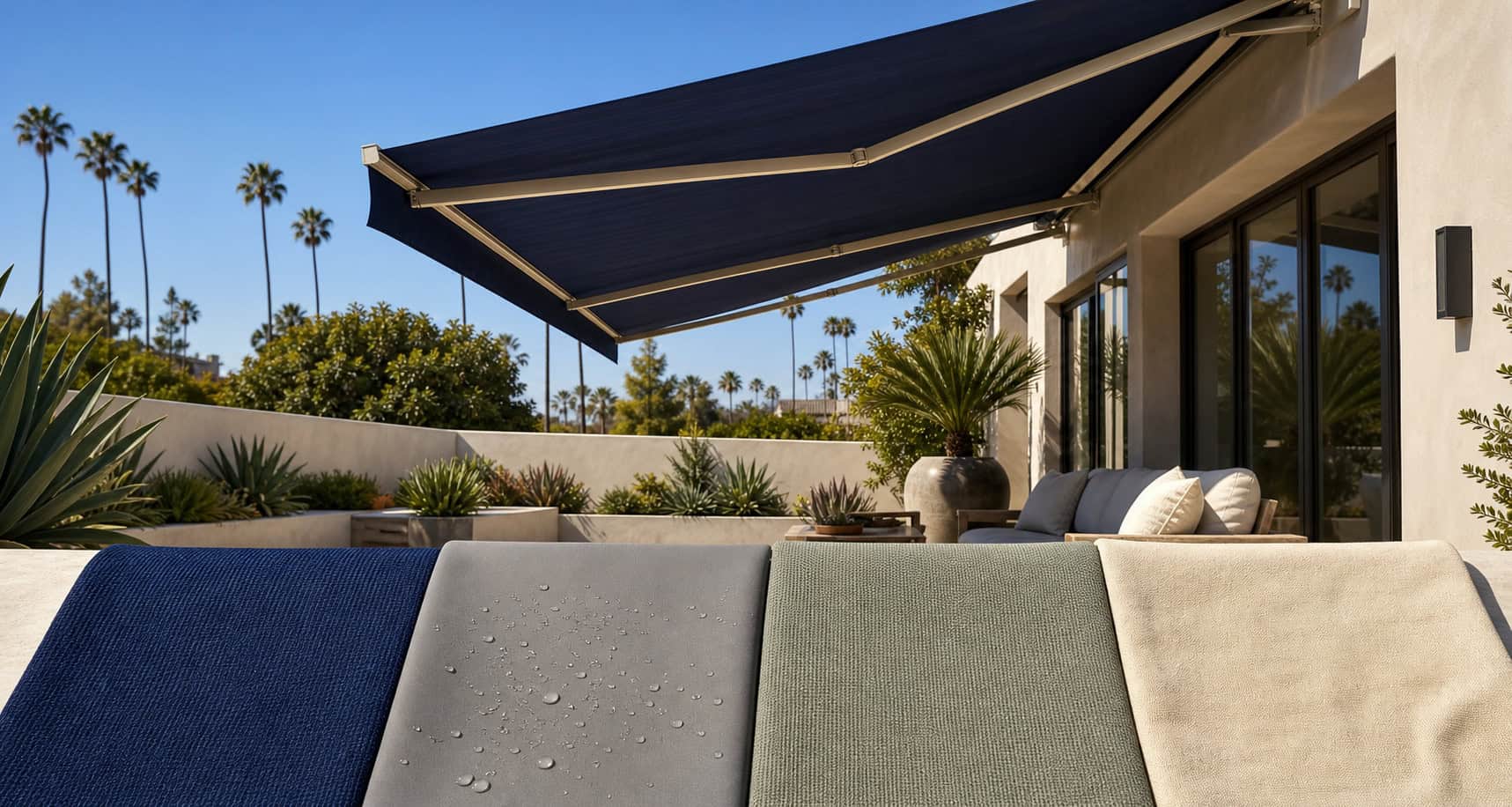
For most residential awnings in Los Angeles, solution-dyed acrylic is the best overall fabric because it combines strong fade resistance, airflow, water resistance, and low-maintenance outdoor performance. Vinyl-coated polyester is better when rain protection or frequent commercial cleaning matters most, coated woven polyester suits lower-budget projects, and cotton canvas is mainly chosen for a traditional appearance.
The right material still depends on sun and wind exposure, frame compatibility, cleaning requirements, and whether the installation must prioritize airflow, rain protection, or long-term color retention.control: Exterior mesh shade fabric.
- Why Los Angeles Conditions Are Hard on Awning Fabric
- The Four Main Awning Fabric Types
- The One Thing Every Fabric Type Shares in LA
- The Best Awning Fabric for Los Angeles — Our Recommendation
- When to Choose Vinyl-Coated Polyester
- Ask for These Specifications Before Buying
- Dark Colors vs. Light Colors — What Actually Stays Cooler in LA
- How Long Will Awning Fabric Last in Los Angeles?
- Signs Your Awning Fabric Needs Replacing
- Professional Installation vs. DIY — What LA Homeowners Should Know
- Best Awning Fabric for Your Patio — LA Outdoor Living Guide
- Commercial Awning Fabric in Los Angeles — What Businesses Need
- Which Awning Fabric Should You Choose?
- Acrylic vs. Vinyl Awning Fabric — Head-to-Head for LA Conditions
- UV-Resistant Awning Fabric — What the Ratings Mean and What to Ask For
- Maintenance and Care by Fabric Type
- Awning Fabric Replacement Cost in Los Angeles
- Is Sunbrella Awning Fabric Worth It for Los Angeles?
- Disclaimer
- Author & Content Transparency
Why Los Angeles Conditions Are Hard on Awning Fabric
Los Angeles combines prolonged UV exposure, long dry periods, heat, and seasonal Santa Ana winds. Together, these conditions accelerate fading, coating deterioration, seam stress, and fabric fatigue. Other high-sun regions create similar challenges, but Los Angeles awnings often remain exposed for more of the year because outdoor spaces are used in every season.
UV exposure is usually the main source of long-term fabric degradation in Los Angeles, while wind, coastal moisture, dirt, poor drainage, and incorrect tension can accelerate failure.
The Four Main Awning Fabric Types
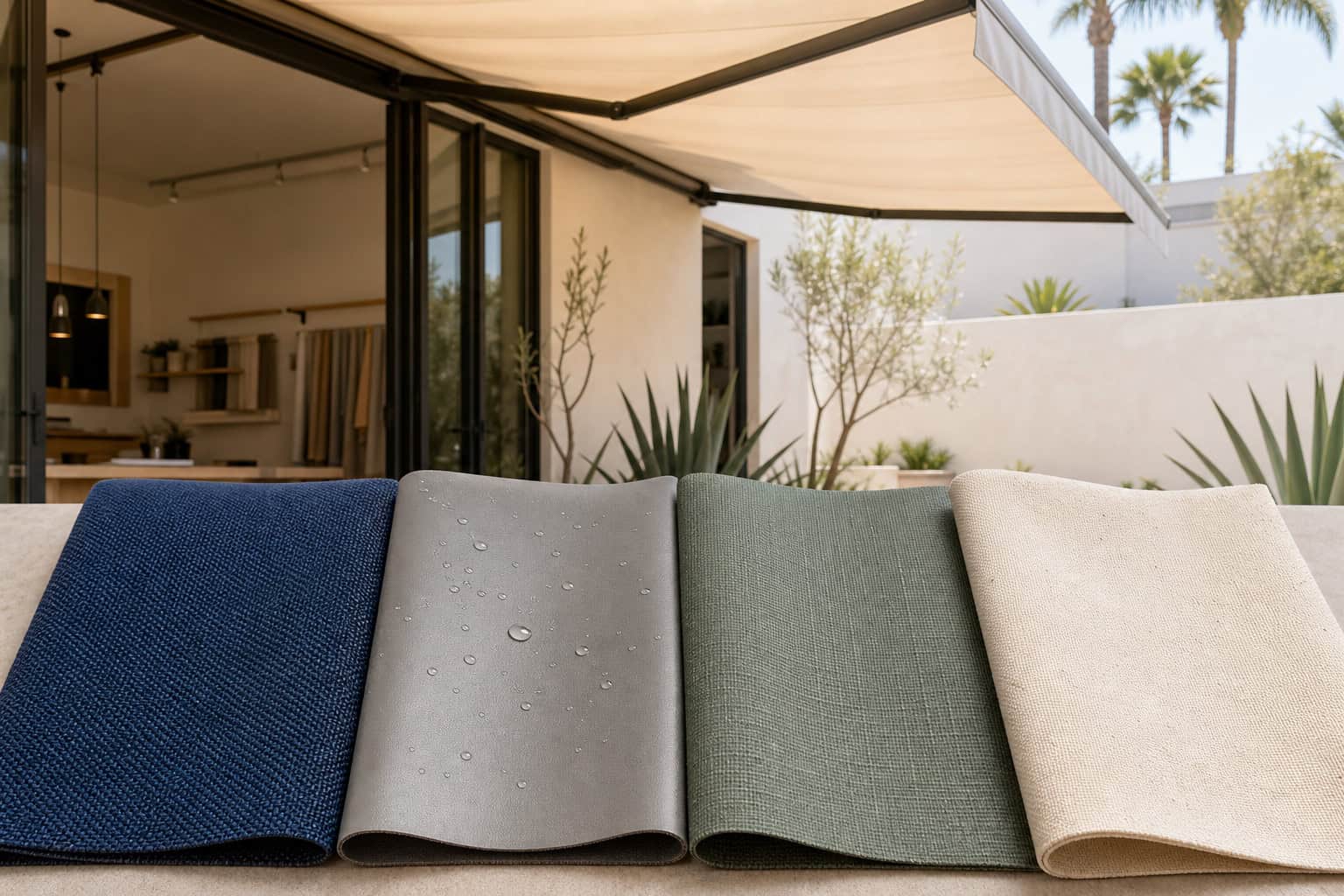
Awning fabric names often mix fiber type, construction, dye method, and surface treatment. Acrylic and polyester describe base fibers, canvas describes a tightly woven construction, solution-dyed describes how pigment is added, and vinyl-coated describes a waterproof finish. A fair comparison should therefore consider fiber composition, weave, coating, performance ratings, and intended use separately.
The fabric is only one part of the finished system. Review the available awning materials to understand how fabric, framing, coatings, and structural components work together.
| Fabric type | Best for | Water performance | Breathability | UV/fade resistance | Cleaning | Typical lifespan | Relative cost |
|---|---|---|---|---|---|---|---|
| Solution-dyed acrylic | Patios, windows, residential shade | Water-resistant, not fully waterproof | High | Excellent when solution-dyed | Brush, rinse, and mild soap | 10–15 years | Premium |
| Vinyl-coated polyester | Restaurants, storefronts, rainy exposure | Waterproof surface, seams may leak | Very low | Good to excellent | Easy to wipe, some products allow controlled low-pressure washing | 8–12 years | Mid-range |
| Coated woven polyester | Budget, retractable, and shorter-term installations | Depends on coating | Moderate | Varies from fair to good | Easy | 3–7 years | Budget |
| Cotton canvas | Traditional or decorative installations | Requires treatment | High | Low | Frequent care and periodic retreatment | 3–5 years | Varies |
Solution-Dyed Acrylic
Solution-dyed acrylic is made by adding pigment to the liquid polymer before the fibers are formed. Because the pigment is distributed throughout the fiber rather than applied only to the surface, the material generally retains color longer than piece-dyed or printed alternatives. The fabric is tightly woven and breathable, so heat passes through instead of building up underneath. The synthetic fiber is inherently mildew-resistant, although mildew can still develop on accumulated dirt or organic debris, which still makes it well suited to demanding outdoor applications. Sunbrella fabrics remain the most widely recognized product line, while Dickson and Recacril offer comparable solution-dyed acrylic alternatives, each with their own weave, coating, and warranty terms. Compare individual products by weight, colorfastness, warranty, and intended use rather than assuming all fabrics from one brand perform identically. The same tightly woven construction shows up on boat covers and marine canvas, which face comparable sun and salt exposure.
Vinyl-Coated Polyester
Vinyl-coated polyester uses a woven polyester base covered with PVC, creating a smooth, impermeable fabric surface highly resistant to water. It is easy to clean and resists grease, staining, and rain, giving it strong weather resistance for storefronts and restaurant awnings. The tradeoff is low breathability, so heat can build beneath the awning. The fabric may be waterproof, but seams, stitching, wall connections, and inadequate pitch can still allow leakage. If you’re weighing this against acrylic, the real question isn’t which fabric is “better” — it’s whether wipeable, grease-resistant performance matters more to your space than a cooler, breathable underside.
Coated Woven Polyester
Woven polyester spans various fabric options and several quality levels. Entry-level products use lighter yarns and basic coatings. Commercial-grade products typically use heavier polyester scrims paired with acrylic-coated, polyurethane-coated, or PVC-coated finishes. Untreated or lightly coated polyester generally fades faster than solution-dyed acrylic, but premium coated polyester can provide strong tear resistance and water resistance. Yarn quality, weave density, coating chemistry, tensile strength, tear strength, and UV stabilization are the key factors that separate entry-level polyester from highly durable, commercial-grade products.
Canvas (Cotton Duck)
Cotton canvas is the traditional awning material, valued for its natural look and breathability. It is usually less practical for a permanent Los Angeles installation. Cotton generally loses color and strength faster than synthetic awning fabrics under continuous UV exposure, especially when protective treatments are not regularly renewed. In humid climates or coastal fog, it’s also prone to mildew. Canvas doesn’t offer the easy maintenance of coated fabrics, so it suits temporary or decorative projects better than year-round use. If the traditional look is non-negotiable, budget for the retreatment schedule up front rather than treating it as an occasional chore — that’s what keeps canvas from becoming a recurring disappointment.
The One Thing Every Fabric Type Shares in LA
Fading, heat buildup, and mildew risk vary by material, as the breakdown above shows. But one failure point doesn’t discriminate by fabric type: wind. Santa Ana winds can damage any material at seams, hems, roller attachments, and frame connections regardless of how well the fabric itself resists sun and moisture. Pairing the right fabric with correct tension and secure hardware matters as much as the fabric choice itself.
The Best Awning Fabric for Los Angeles — Our Recommendation
For most residential patios, window awnings, and appearance-led storefronts in Los Angeles, solution-dyed acrylic is the strongest overall choice. It combines long-term color retention, airflow, water resistance, and relatively low maintenance. Vinyl-coated polyester is better when the project requires a waterproof fabric surface, grease resistance, or frequent commercial cleaning. Coated woven polyester is suitable when budget matters more than maximum fade resistance.
For homeowners, fabric selection should also account for the awning style, frame, projection, and the area being shaded. Explore residential awnings in Los Angeles to compare complete systems for patios, windows, and entrances.
Not Sure Which Fabric Fits Your Awning?
The best choice depends on sun exposure, frame type, cleaning needs, wind conditions, and whether you need airflow or stronger rain protection. Request a free consultation to review your installation before choosing a material.
Request a FREE Consultation
When to Choose Vinyl-Coated Polyester
Choose vinyl-coated polyester when waterproofing, grease resistance, stain resistance, or frequent cleaning matters more than airflow. It is often appropriate for restaurant entrances, food-service patios, storefront valances, and other high-use commercial installations that need dependable shade protection. These cleaning and weather-resistance requirements are particularly important when planning restaurant awnings.
Some products tolerate controlled low-pressure washing, but cleaning limits vary by manufacturer and may affect the warranty. Commercial installations often need flame-retardancy documentation against standards like NFPA 701 or CPAI-84. The applicable standard depends on the fabric, structure, occupancy, and jurisdiction, so confirm the exact requirement with your local building department and fabric supplier before ordering.
Ask for These Specifications Before Buying
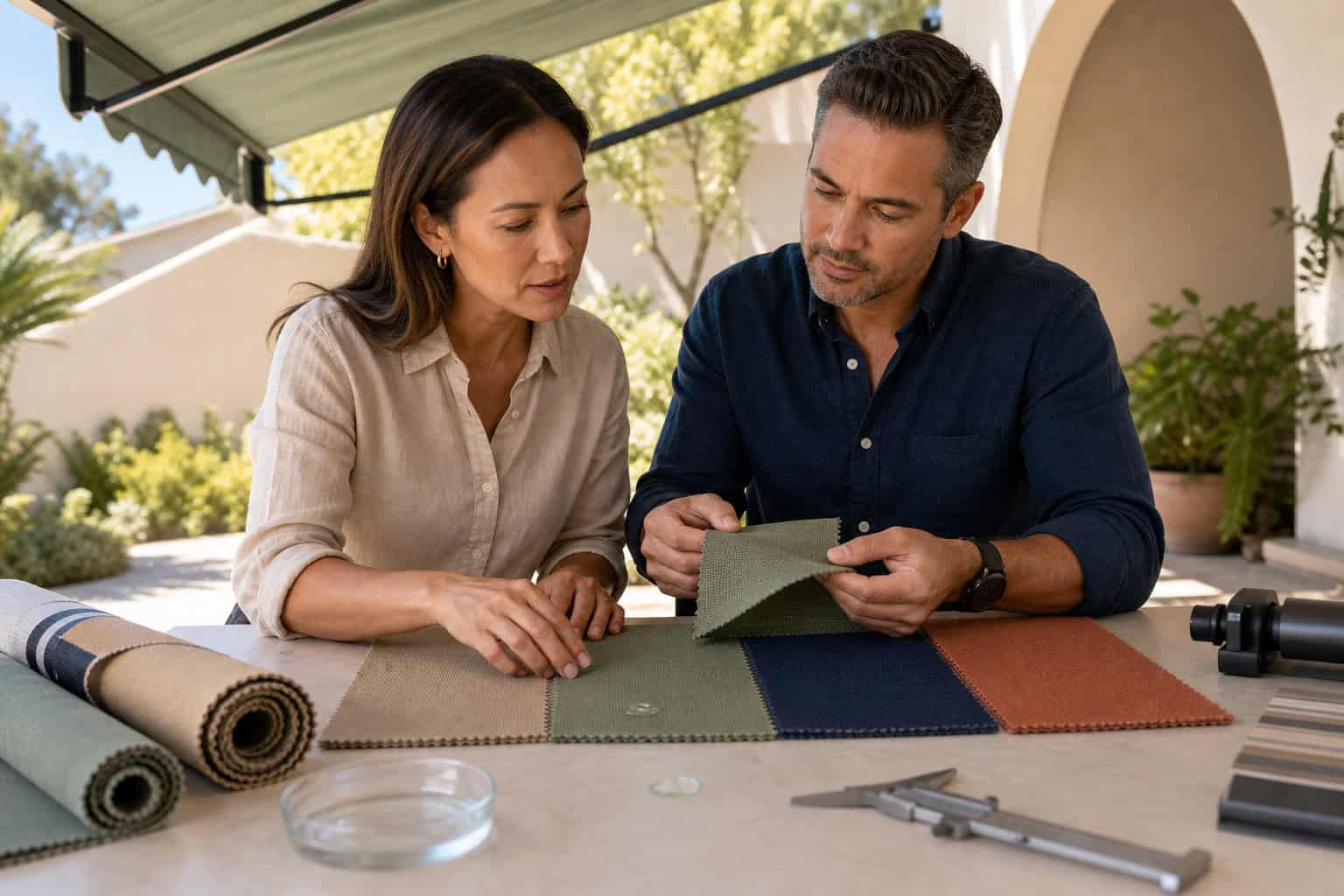
A handful of specs tell you more about fabric quality than the brand on the label:
- Fiber and construction. Confirm the base fiber, weave or scrim construction, dye method, coating, and intended application.
- Weight and thickness. Compare weight and thickness with the frame manufacturer’s limits. Heavier fabric may offer more substance but can overburden retractable hardware.
- Tensile and tear strength. Tensile strength indicates how the fabric handles pulling forces, while tear strength indicates how well it resists an existing cut or puncture from spreading.
- Water performance. Determine whether the product is water-repellent, water-resistant, or waterproof, and ask whether the rating applies to the fabric surface or the finished awning system.
- UPF rating. A UPF 50+ rating means roughly 2% or less of measured UV radiation passes through the fabric, offering long-lasting protection against sun damage. According to the Skin Cancer Foundation, a fabric must reach a minimum UPF of 50 to qualify for its Seal of Recommendation, and some awning-grade acrylic fabrics carry that seal.
- Colorfastness. Ask which test method was used and whether the result applies to the exact color being purchased.
- Dimensional stability. Confirm the material won’t stretch or shrink excessively. This is especially important on retractable systems and large fixed spans.
- Cleaning instructions. Confirm whether bleach, pressure washing, degreasers, or solvents can damage the coating, printing, stitching, or warranty.
- Roll width. Wider material can reduce the number of seams on large awnings.
- Warranty. Review fading, strength loss, coating failure, cracking, peeling, and labor exclusions separately, and check whether labor, removal, reinstallation, and shipping are excluded.
Get Help Comparing Awning Fabric Specifications
Fabric weight, tear strength, water performance, colorfastness, frame compatibility, and warranty terms can vary substantially between products. Speak with an awning specialist who can help you compare the specifications that matter for your installation.
Dark Colors vs. Light Colors — What Actually Stays Cooler in LA
Light colors reflect more solar radiation and stay cooler to the touch, while dark colors absorb more heat at the surface. Darker and denser fabrics often reduce visible light and glare more effectively, but color alone doesn’t determine UPF. Compare the tested UPF rating of the exact fabric and color rather than assuming a dark awning blocks more UV. A dark awning can still create a more shaded space below even though the fabric itself runs hotter. Mid-tone colors like tan, gray, or sage often provide a practical balance between surface temperature, glare control, visible soiling, and perceived fading. Solution-dyed acrylic is valued for long lasting, fade-resistant color across a wide range of shades, though tested colorfastness can still vary by product and color. The choice ultimately comes down to comfort and personal preference alongside fade performance.
Pattern and opacity affect the practical result too. Stripes and textured patterns often conceal dust and uneven fading better than flat solid colors, and most fabric options come in a range of patterns and solid colors. Opaque fabrics reduce glare and visible light more strongly, while translucent fabrics preserve more daylight beneath the awning. Neither term alone indicates UV performance, so compare the tested UPF rating. Commercial buyers should also confirm print compatibility and color consistency across replacement batches.
How Long Will Awning Fabric Last in Los Angeles?
Service life varies by product, exposure, maintenance, frame condition, fabric tension, and how often the awning is retracted. The following figures are broad planning ranges rather than guarantees. Solution-dyed acrylic may last roughly 10 to 15 years with regular cleaning and proper installation. Vinyl-coated polyester often falls in an 8-to-12-year range before noticeable coating stiffness, cracking, seam wear, or loss of appearance may occur. Coated woven polyester may last approximately 3 to 7 years, and cotton canvas often requires earlier replacement, around 3 to 5 years, unless carefully maintained. Regular cleaning, securing the awning during Santa Ana winds, and correct tension all extend fabric life.
Signs Your Awning Fabric Needs Replacing
A few warning signs tell you when fabric is past saving:
- Fading or bleaching, especially in center panels facing the midday sun
- Water pooling instead of beading and running off
- Mold or mildew stains that don’t respond to cleaning
- Fraying or splitting at seams, the valance edge, or the roller attachment
- Sagging that doesn’t correct after re-tensioning
- Coating that peels, cracks, or becomes sticky
- Repeated seam leakage or attachment-point failure
Fading alone does not always require replacement if the fabric remains structurally sound. However, fraying, seam separation, coating failure, persistent sagging, or recurring water pooling indicate that repair may no longer be economical. A professional inspection can determine whether the problem is the fabric, tension, hardware, or frame.
Professional Installation vs. DIY — What LA Homeowners Should Know
DIY fabric replacement is possible on a standard retractable awning, where fabric commonly attaches through pockets, splines, or keder-style edges. Fabric weight, stretch, and attachment method are especially important for retractable awnings, because the material must remain compatible with the roller, motor or spring system, projection, and frame capacity. Custom-sized fixed awnings, multi-story installs needing scaffold access, and systems where spring tension is part of the fit are better left to a professional. Incorrect tensioning commonly causes premature failure. Retractable awnings may contain loaded springs or motorized components, so follow the frame manufacturer’s service instructions before releasing tension, and check whether DIY replacement affects the fabric or equipment warranty.
Frame and Installation Compatibility
The best fabric can still perform poorly when it’s incompatible with the frame. Heavy vinyl may overburden a retractable mechanism designed for lighter acrylic, while a fabric with excessive stretch can sag between fixed supports. Confirm the roller diameter, motor or spring capacity, approved fabric weight, spline or pocket size, seam layout, projection, attachment method, and minimum slope for runoff before ordering replacement material.
Permit and fire-code requirements vary among the City of Los Angeles, incorporated cities, and unincorporated Los Angeles County. According to the Los Angeles County Department of Public Works, some small structures are exempt from a permit in unincorporated LA County, though thresholds differ by city. Confirm the current rules with the authority having jurisdiction before fabrication or installation.
The material overview above identifies the main differences. The following sections apply those differences to patios, commercial properties, UV performance, maintenance, installation, and cost.
Best Awning Fabric for Your Patio — LA Outdoor Living Guide
Patio awnings in Los Angeles often remain in use throughout the year, so they accumulate more annual UV exposure than awnings that are stored or retracted during long winters.
West-facing patios take the most direct hit from LA’s afternoon sun, so fabric choice matters more there than on a shaded east-facing patio that only sees morning light. For most patio configurations, solution-dyed acrylic remains the strongest fit because it stays breathable during long outdoor gatherings, which matters given how much of LA’s social life happens outdoors. Larger patio awnings benefit from acrylic products with enough weight, dimensional stability, and tensile strength to span the frame without excessive sagging.
The appropriate fabric also depends on the patio’s orientation, projection, frame type, and whether the system is fixed or retractable. See the available patio awning options before selecting fabric by material alone. The fabric should still stay light enough for the retractable mechanism, if one is used.
Commercial Awning Fabric in Los Angeles — What Businesses Need
Commercial awnings are selected around cleaning frequency, branding, fire documentation, frame size, access, operating hours, and exposure to the elements. Weight matters, but the correct specification depends on the material and system rather than on a universal commercial minimum.
Fabric is only one part of a commercial awning specification. Businesses should also evaluate frame construction, graphics, cleaning requirements, access, fire documentation, and installation conditions when planning commercial awnings in Los Angeles.
Weight and cleaning requirements
Heavy-duty commercial vinyl and coated-polyester products generally run heavier per square yard than standard residential fabric, while commercial-grade solution-dyed acrylic tends to be lighter by comparison. Suitable weight depends on span, wind exposure, frame design, printing, and manufacturer requirements, so ask your supplier for the exact weight spec sheet for the product under consideration rather than relying on a rule of thumb. Restaurants and food-service businesses need fabric that tolerates cleaning and resists grease and soot, which favors vinyl-coated polyester over standard acrylic in most cases. Some commercial vinyl-coated fabrics tolerate controlled low-pressure washing, but always follow the manufacturer’s cleaning limits to avoid damaging coatings, seams, or printed graphics.
Fire code documentation
Fabric here is often required to carry flame-retardancy certification, commonly referenced against standards like NFPA 701 or CPAI-84. The specific requirement depends on the structure type, its use, and the jurisdiction. Ask for a current certificate tied to the exact fabric product, color, and treatment rather than relying on a generic marketing statement. Confirm with your local building and fire department, and ask your fabric supplier for documentation before ordering.
Pricing structure
Commercial fabric replacement is typically priced by square footage plus structural access complexity. Multi-story storefronts or awnings over public sidewalks often require scaffolding, lift rental, or permit coordination that a single-story residential patio awning doesn’t need. Graphic removal, reprinting, sewing, hardware replacement, and after-hours installation may also affect commercial pricing. The practical takeaway for a business owner: get quotes that separate fabric cost from access and labor, since two bids with the same fabric can land far apart once scaffolding or after-hours work enters the picture.
Which Awning Fabric Should You Choose?
- Choose solution-dyed acrylic for patios, windows, retractable awnings, and storefronts where airflow and appearance are priorities.
- Choose vinyl-coated polyester for restaurants, rain-exposed entrances, and installations requiring frequent cleaning.
- Choose coated woven polyester for price-sensitive or shorter-term projects, provided the product is rated for the frame and UV exposure.
- Choose mesh shade fabric for pergolas, solar shades, and ventilated structures where glare reduction matters more than rain protection.
- Choose cotton canvas for traditional or decorative installations where periodic retreatment and more frequent maintenance are acceptable.
Mesh shade fabric is a smaller product class worth knowing. It’s a loosely woven or knitted material used on pergolas, exterior solar shades, and some freestanding canopies where ventilation and glare control matter more than keeping rain out entirely.
Acrylic vs. Vinyl Awning Fabric — Head-to-Head for LA Conditions
Acrylic and vinyl solve different problems, so comparing them head-to-head means looking at the specific property that matters for a given installation rather than picking an overall winner.
| Property | Solution-Dyed Acrylic | Vinyl-Coated Polyester |
|---|---|---|
| Breathability | High | Very low |
| Waterproofing | Water-resistant, not fully waterproof | Waterproof fabric surface, installed system may leak |
| Cleaning | Mild soap and water | Easy to wipe, some products permit low-pressure washing |
| Typical weight | 8–10 oz/sq yd | Product-dependent, often heavier than acrylic |
| Heat underneath | Cooler, breathes | Warmer, traps heat |
| Typical lifespan in LA | Broad planning range, product-dependent | Broad planning range, product-dependent |
| Best fit | Residential patios, boutique storefront | Restaurants, high-traffic commercial |
| A hybrid design may use acrylic for the main body and vinyl or reinforced trim at high-wear edges. This should be engineered and fabricated as a compatible system, because different materials stretch, age, and respond to tension differently. |
What “Waterproof” Actually Means
A waterproof fabric doesn’t automatically create a waterproof awning system. Needle holes, welded or sewn seams, wall flashing, side gaps, valances, and inadequate slope can all admit water. Pooling also creates structural loads that the frame may not be designed to carry. Breathable acrylic sheds ordinary rain well, but acrylic awning fabric should not be treated as a code-compliant permanent roof or guaranteed dry enclosure. For real rain protection, evaluate the complete system rather than the fabric alone, including seam construction and the pitch that directs water runoff.
UV-Resistant Awning Fabric — What the Ratings Mean and What to Ask For
“UV-resistant” may refer to the fiber’s resistance to degradation, the pigment’s resistance to fading, the coating’s weathering performance, or the fabric’s ability to block UV from passing through. These are related but separate properties.
Independent test methods exist to measure how well a fabric holds color under prolonged sun exposure. Different methods evaluate outdoor exposure, accelerated light exposure, color change, or strength retention, so ask what the test actually measured. The American Association of Textile Chemists and Colorists publishes AATCC Test Method 16.1, a standardized procedure for testing colorfastness to outdoor light exposure. A supplier who can point to results from a recognized test method is giving you a stronger signal of real performance. That beats a fabric just printing “UV resistant” on a spec sheet with no data behind it.
What to ask a supplier
- Which accelerated-weathering method was used, and for how many exposure hours
- Whether color change and strength loss were both measured
- Whether the warranty covers fading and strength, not just manufacturing defects
- Whether the product is rated for awning use specifically, not just outdoor upholstery
- Whether cleaning with bleach or pressure washing affects warranty coverage
- Whether results apply to the exact fabric color and coating
- Whether the test measured cracking, chalking, or coating adhesion
- Whether the product has outdoor awning approval rather than only upholstery use
UPF (ultraviolet protection factor) measures how much UV radiation passes through the fabric to reach someone sitting underneath. That’s a different question from how well the fabric resists fading. Ask for both a UPF rating and separate evidence of colorfastness and strength retention.
Maintenance and Care by Fabric Type
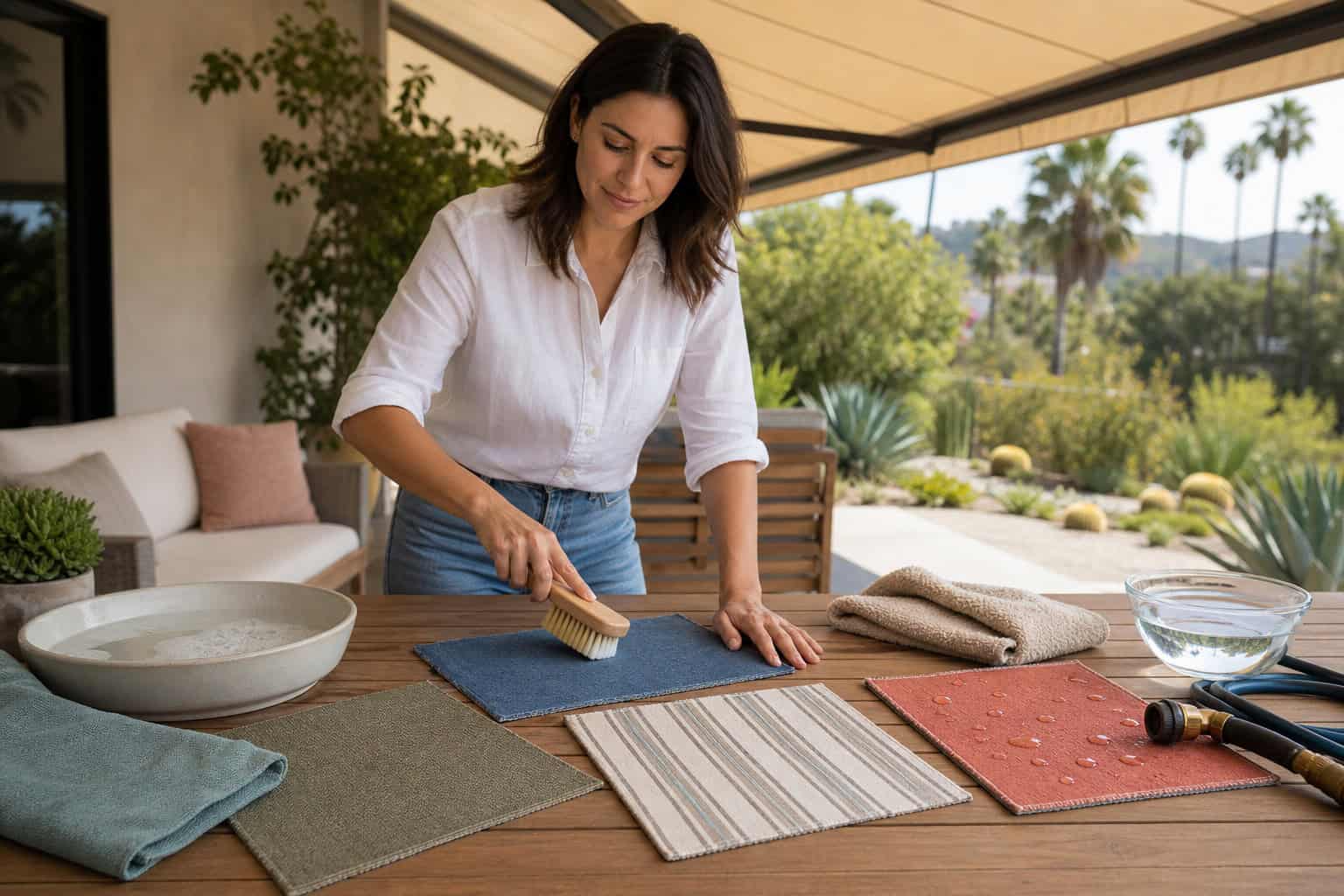
Regular care determines how close a fabric gets to its expected lifespan, and easy maintenance varies quite a bit by material. Cleaning frequency should increase near traffic, restaurants, trees, construction dust, or coastal salt exposure.
| Material | Routine cleaning | Avoid | Inspection frequency |
|---|---|---|---|
| Solution-dyed acrylic | Brush debris, rinse, mild soap | Harsh solvents, storing while damp, or letting dirt embed in the weave | Twice yearly |
| Vinyl-coated polyester | Rinse and wipe with an approved cleaner | Abrasive tools, unapproved solvents, or coating abrasion from harsh scrubbing | Quarterly for commercial use |
| Coated woven polyester | Follow coating-specific instructions | Strong bleach unless approved, or cleaners incompatible with the coating | Twice yearly |
| Cotton canvas | Gentle cleaning and periodic re-treatment | Prolonged dampness, aggressive washing, or loss of water repellency | Every few months |
| A few habits apply across all materials. Remove leaves and debris before they embed in the weave, and let fabric dry completely before retracting or folding. Inspect seams and fasteners during routine cleaning, avoid pressure washing unless the manufacturer approves it, and re-treat water repellency only with a compatible product. Always follow the product manufacturer’s instructions when they differ from these general intervals. |
Coastal Los Angeles Considerations
In coastal areas, salt, morning moisture, and airborne dirt can collect on the fabric even when the fiber itself resists mildew and mold. Mold and mildew commonly grow on dirt, pollen, food residue, and other organic material collected on the fabric rather than on the synthetic fiber itself. Salt exposure also affects fasteners, brackets, motors, and frames, so stainless or corrosion-resistant components may be appropriate in exposed coastal installations. Periodic freshwater rinsing, complete drying before retraction, and inspection of metal fasteners are especially important near the coast.
Awning Fabric Replacement Cost in Los Angeles
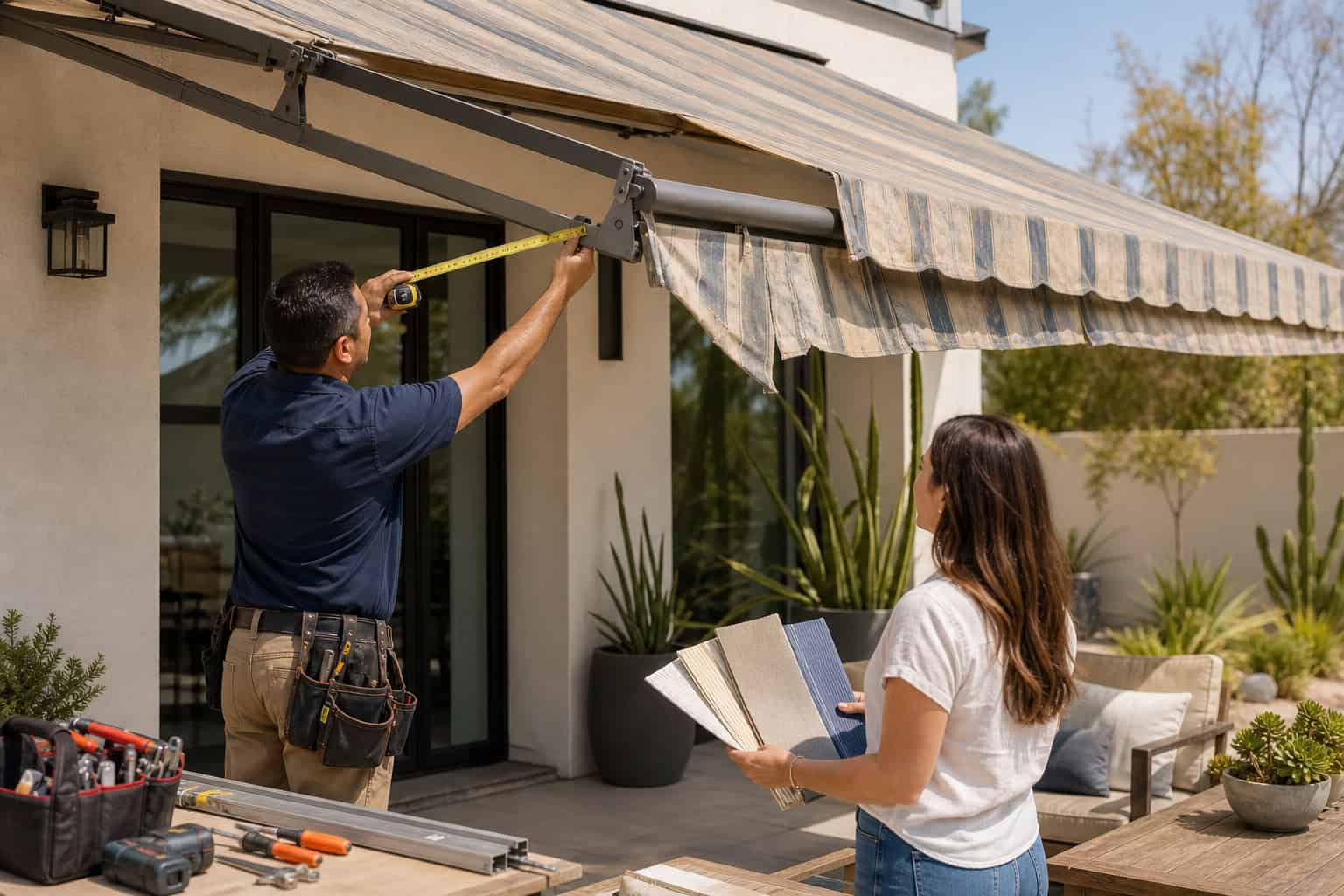
Replacement cost depends on fabric grade, awning dimensions, sewing complexity, access, frame condition, removal, disposal, and whether graphics or permits are involved, although labor rates and company scope also vary. In practice, project costs generally fall into a few predictable planning ranges, though local LA labor and material costs can push totals toward the higher end of any national benchmark.
National cost guides put typical awning fabric replacement around $4 to $8 per square foot, with most homeowners spending an average of roughly $790 on a standard residential job, according to Angi’s 2026 cost data. Premium solution-dyed acrylic, custom sewing, and California labor rates commonly push Los Angeles pricing above that national figure, so treat it as a floor rather than a typical quote. A larger custom or commercial storefront re-cover, especially one requiring scaffolding, graphics, or permit coordination, can run well past a single-awning residential job.
Several factors drive price beyond the fabric itself. Custom sizing adds cost, since most LA installations are cut to fit rather than off-the-shelf. Multi-story access that requires scaffolding or lift rental adds more. Permit costs apply to larger commercial structures, and fabric brand and weight shift the total either way. A low quote often reflects a lighter fabric grade rather than a more efficient installer, so ask exactly which material a quote is based on before comparing prices. Confirm whether quotes include fabric, fabrication, sewing, removal, installation, hardware, tax, permits, and disposal.
The figure above is a national planning benchmark as of 2026, not a Los Angeles quote. Get itemized bids from local installers for an accurate number, since it generally assumes standard access and won’t include removal and disposal of old fabric, structural repairs, custom graphics, or permit fees, which may be billed separately.
Is Sunbrella Awning Fabric Worth It for Los Angeles?
Sunbrella can be worth the premium for Los Angeles homeowners who value a widely specified product line, broad color availability, established warranty coverage, and installer familiarity.
Sunbrella publishes a 10-year limited warranty on its shade and marine fabrics, and a 5-year limited warranty on its upholstery, specialty, and decorative shade fabrics. That’s according to Sunbrella’s published warranty terms. Coverage depends on which product line is specified, so that distinction matters when comparing a quote.
Sunbrella isn’t the only solution-dyed acrylic option. Dickson and RECacril also offer solution-dyed acrylic product lines used by commercial installers in California. Compare specific product lines rather than brands in the abstract. Review fiber type, weight, intended application, colorfastness, water performance, warranty exclusions, and local installed price rather than assuming one brand is cheaper or better across the board.
Get a Recommendation Based on Your Existing Awning
Before comparing prices, confirm whether your frame can be reused, which fabric is compatible, and whether the project requires new hardware, custom fabrication, access equipment, or permit coordination. Request a free consultation to discuss the condition, dimensions, and exposure of your awning.
Frequently Asked Questions
What is the best awning fabric for Los Angeles?
Solution-dyed acrylic is the best overall choice for most residential awnings and appearance-led storefronts because it combines color retention, airflow, and water resistance. Vinyl-coated polyester is better when a waterproof fabric surface, grease resistance, or frequent cleaning is the priority. See the comparison table above for the full breakdown.
How long does awning fabric last in Los Angeles?
Typically three to fifteen years depending on material and maintenance, though these figures are planning ranges rather than guarantees. Solution-dyed acrylic holds up longest, followed by vinyl-coated polyester, then coated woven polyester and canvas, as detailed in the lifespan section above. Regular cleaning and securing fabric during wind events extend all of these ranges.
When should I replace my awning fabric?
Replace once you see structural failure rather than cosmetic wear, including fraying, seam separation, coating failure, persistent sagging, or recurring water pooling. Fading alone doesn’t always mean replacement is needed if the fabric is still structurally sound. For a storefront where appearance drives business, though, fading can be reason enough on its own.
What awning fabric is like Sunbrella but cheaper?
Dickson and RECacril are common solution-dyed acrylic alternatives to Sunbrella, widely used by commercial installers in California, but pricing varies by product line, color, weight, dealer, and warranty. Compare UV rating, weight, and warranty length side by side rather than assuming either brand is cheaper across the board.
What is the most UV-resistant awning fabric for the Los Angeles sun?
Solution-dyed acrylic with a UPF 50+ rating is often the strongest all-around option for both UV blockage and long-term outdoor color retention, provided the exact product carries appropriate test results. UPF and fade resistance are separate measurements. Ask suppliers for both a UPF rating and a recognized colorfastness test result like AATCC’s, rather than relying on “UV resistant” marketing language alone.
What is the best awning material for hot weather and heat resistance in Los Angeles?
For occupied spaces like patios, breathable solution-dyed acrylic is the better choice, since it lets air move through instead of trapping heat. Vinyl-coated polyester may provide strong weathering performance, but its sealed surface generally traps more heat beneath the awning. Lighter, mid-tone colors help either material stay cooler at the surface.
How much does awning fabric replacement cost in Los Angeles?
National cost guides put typical fabric replacement around $4 to $8 per square foot, but premium solution-dyed acrylic, custom sewing, and LA labor rates commonly push local pricing above that baseline, especially for larger custom or commercial jobs. See the cost section above for the full breakdown, including what these ranges include and exclude.
What are the different awning material types and which lasts the longest??
The main awning material types are solution-dyed acrylic, vinyl-coated polyester, coated woven polyester, and cotton canvas, plus mesh shade fabric for ventilated applications. Solution-dyed acrylic generally lasts longest in Los Angeles conditions, and each type solves a different problem beyond lifespan alone, covered in the fabric type table above.
Can I replace my patio awning fabric myself or do I need a professional?
DIY works for a standard retractable awning with a common frame size and a straightforward pocket, spline, or keder-style attachment. Custom-sized, hard-to-access, or spring-tensioned systems are better left to a professional, since incorrect tensioning is one of the most common causes of early fabric failure. Loaded springs or motorized components also carry real safety risk if handled incorrectly. Some warranties also require professional installation to stay valid.
What is the best commercial awning fabric for a restaurant or business in Los Angeles?
Vinyl-coated polyester is generally the better fit for restaurants because it wipes clean and resists grease and steam, and may tolerate controlled low-pressure washing when the manufacturer permits it. Retail storefronts where appearance matters more than heavy cleaning often do better with commercial-weight solution-dyed acrylic. Either way, confirm flame-retardancy documentation appropriate for your structure, since requirements vary by jurisdiction.
Disclaimer
The information on this page is provided for general informational purposes only. It is not intended as engineering, construction, legal, fire-safety, or product-specific professional advice.
The durability and performance of solution-dyed acrylic fabric, acrylic-coated polyester, vinyl-coated polyester, cotton canvas, and exterior mesh vary by product, color, coating, installation method, frame compatibility, weather exposure, and maintenance. Lifespan and cost figures are general planning estimates rather than guarantees or Los Angeles quotations.
Claims concerning UV protection, UPF ratings, long-lasting color, water resistance, and expected service life must be verified for the exact fabric and color selected. References to excellent UPF protection or recognition from organizations such as the Skin Cancer Foundation apply only when supported by current documentation for the specific product.
Permit, building-code, fire-retardancy, and product-certification requirements vary across the City of Los Angeles, incorporated cities, and unincorporated Los Angeles County. Requirements may also change over time. Before purchasing or installing awning fabric, confirm current requirements with the relevant building or fire department, fabric supplier, manufacturer, and a properly licensed California contractor.
A waterproof fabric does not necessarily create a waterproof awning system. Seams, stitching, slope, flashing, attachment points, drainage, and frame design can affect water resistance and structural performance. Product warranties, cleaning instructions, flame-retardancy certifications, UPF ratings, and compatibility requirements should be verified before purchase.
This content does not guarantee product performance, durability, service life, code compliance, permit approval, installation suitability, or project cost.
Author & Content Transparency
This article was developed to help Los Angeles homeowners, property managers, and business owners compare solution-dyed acrylic fabric, vinyl-coated polyester, acrylic-coated or otherwise coated woven polyester, cotton canvas, and exterior mesh awning materials.
The content draws on:
- Publicly available guidance from building, fire-safety, textile-testing, and sun-protection organizations
- Published manufacturer specifications, warranties, and maintenance instructions
- Information about solution-dyed acrylic fibers, coatings, textile construction, UV protection, color retention, and durability
- General awning fabrication, installation, cleaning, and maintenance practices
- Climate considerations relevant to Los Angeles, including intense UV exposure, heat, coastal moisture, dirt, and Santa Ana winds
Manufacturers and organizations—including Dickson Fabrics, RECacril, Sunbrella, and the Skin Cancer Foundation—may be referenced when their published information is relevant. Product and organization names are included for identification and comparison purposes only. No affiliation, sponsorship, or endorsement is implied.
AI tools assisted with research organization and drafting. The content was edited for clarity, relevance, and consistency. Readers should verify product specifications, UPF ratings, warranties, certifications, prices, and local requirements directly with authoritative sources before making purchasing or installation decisions.
This article is educational and cannot replace a site inspection or recommendations from a qualified awning professional, architect, engineer, fabricator, or licensed California contractor.
Last reviewed: July 2026.